|
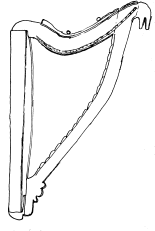
Made in 1702 by Cormac O'Kelly
Owned by Guinness and kept at their Storehouse museum in Dublin.
"High Headed" design;
30 strings, longest 97cm

The Downhill harp at Guinness
The attribution to Cormac O'Kelly comes from a verse inscribed on the side of the instrument's soundbox. There is another inscription on the harp that is less often noticed, "C O DEVLIN" in fine Roman capitals on the forepillar. Presumably this was the harp's first owner. The harp was bought for 18-year-old Denis O'Hampsey (1695-1807) (this would be in 1713 if we accept his claimed year of birth) by his first patron, Counsellor Canning, in Garvagh, Co. Derry, along with two other gentlemen, Gage and Bacon.
Denis O'Hampsey apparently played this harp for the whole of his life after that. He travelled widely in Ireland and Scotland, including a visit to Holyrood House in Edinburgh in 1745 when he played in front of Charles Stuart. In 1792 he was at the Belfast harpers' meeting, where, as the only person there to adhere to the old playing style with long fingernails, and with a very old and conservative repertory, he caught the interest of Edward Bunting. Bunting noted down many tunes from O'Hampsey's playing; amazingly, the manuscripts survive and as well as providing the raw material for 19th century Irish music collections, are the basis of today's revival of the historical Gaelic harp.
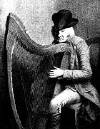
The portrait was made when O'Hampsey was very old; it shows the harp without its distinctive eel head. As the overhanging neck is a "trompe l'oeil" effect - the harp has the usual High Headed construction where the forepillar continues to the top of the bass - the neck of the eel is on the short grain and could easily have broken. Presumably it was kept in the back of the soundbox, or O'Hampsey's coat pocket, and re-attached after his death when the harp was taken to the Downhill house, the home of his patron, Hervey-Bruce.
The harp was preserved at Downhill for some years. It was eventually bought by the Guinness company to display in their museum, even though it has never been used in their publicity - they always use a drawing of the Trinity College harp. Presumably they just wanted an early Irish harp to display and this one came on to the market at the right time?
The harp has never been scientifically studied or measured so we know very little about it, not even what wood it is made from. It has 30 tuning pins and 32 string shoes, which allow 30 brass wire strings to be mounted with some latitude for adjustment. It was tuned to a diatonic scale with a gap in the bass and a doubled note in the tenor - called respectively tead leagaidh and comhluighe.
Simon Chadwick
Student copies of this harp are available for sale from the Historical Harp Society of Ireland. Built by David Kortier, based on his measurements from the original to reproduce its idiosyncratic string spacing, angles and overall ergonomics. Laminated construction and simplified outline keep the price affordable without compromising the historical value of this harp. click here for more info.
