|
|
The Queen Mary harp has three sets of markings on it which could be considered inscriptions.

There are small paper labels stuck to the front of the soundbox, with letters on them, to label certain of the strings. I presume these may date from the early 19th century when the harp was strung in gut and played by Elois, but they could perhaps be older, dating from when the harp was played in the 18th century. They are upside-down, to be read by the (left-oriented) player of the harp, and appear to be cut from a printed sheet, rather than handwritten. The letters and position numbers are as follows, counting from the treble: 1 [illegible], 8 [c], 9 [b], 11 [G], 15 [C], 22 [C]. These letters match the gamut described by Gunn as being settled on through trial and error1.
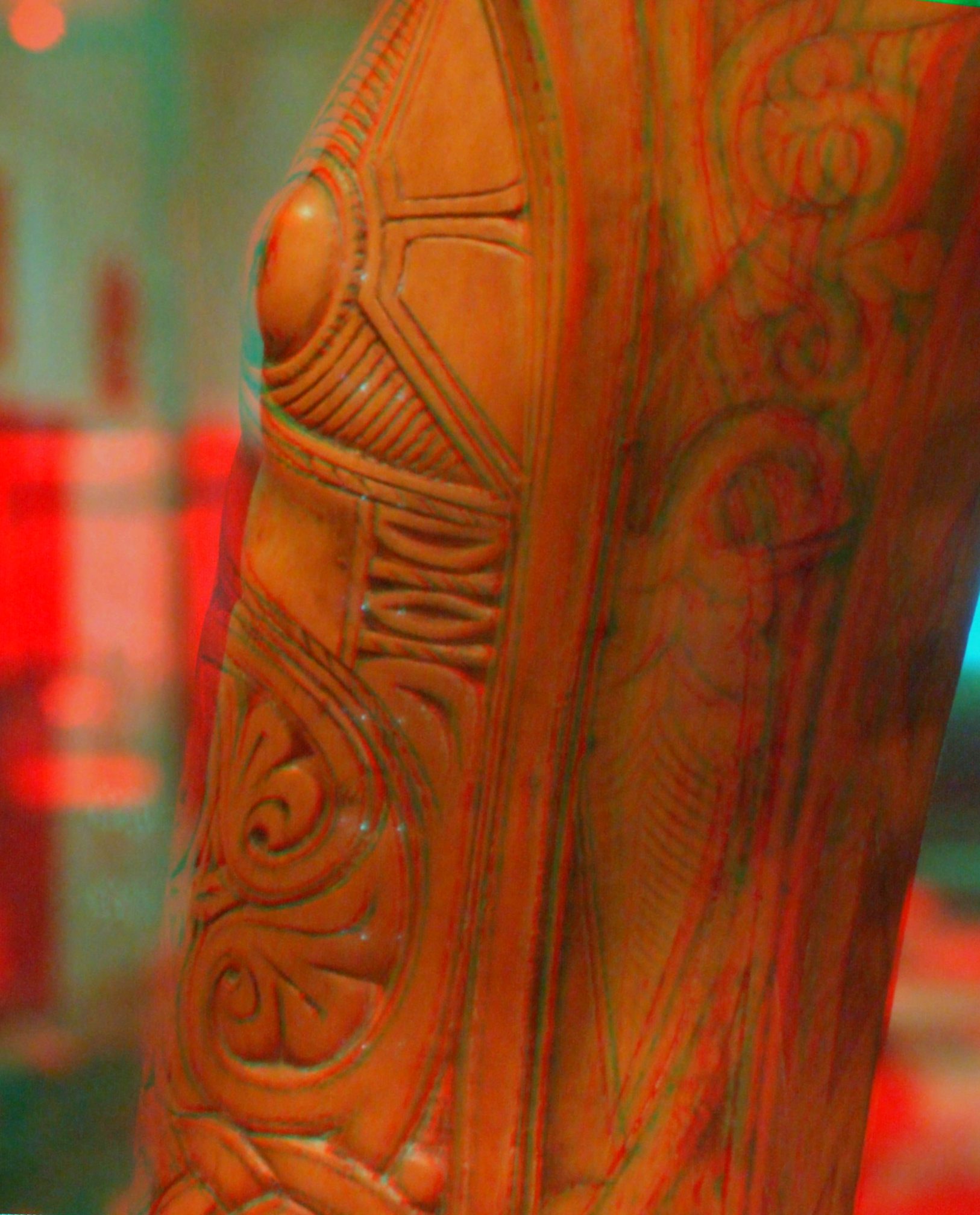
The side of each fish head has carved designs that have been interpreted as the letters DO, perhaps meaning “Deo Oblata” (offered to God)2. There are three fields; the middle is like the letter O; the outer end is like the letter D, and the inner end is wedge shaped to follow the eyebrow of the fish but otherwise is a mirror image of the outer end. There is a vertical braided strip between the three fields as well.
I do not think these are really letters, for two reasons. First, they look more like geometrical designs with the funny wedge-shaped reverse D, and they are identical but mirrored on opposite sides of the fishes - they occur four times, once on each side of both fish heads. Secondly, they are not in either of the two lettering styles used in late medieval West Highland art, Lombardic capitals pre-1500 or gothic letters post-15003. If there were lettering carved on the forpillar I would expect it to match the rest of the decoration by being in one of those two styles.
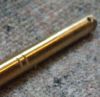
The tuning pins bear hidden scores that have been interpreted as ogam letters4. The scores are only visible when the pins are removed from the harp; Patton4 prints a NMS photograph of the pins laid out on a table. One pin has 6 scores; the remainder between none and five. No stemline seems to be indicated. The visible ends of the pins also bear incised lines and decoration in the form of concentric bands and crosses or cross-hatching. Comparing museum photographs from the early and mid 20th century shows that not only have some pins been lost, but some of the remaining ones have been moved between holes, which shows us that the original order of the pins has not been preserved even over the last 100 years, let along longer.
I do not think these are really ogham letters; they do not have a proper stem line and there are some with 6 scores. I think they must be some kind of tally or counting mark instead.
Simon Chadwick
1. 1. John Gunn, An Historical Enquiry respecting the Performance on the Harp in the Highlands of Scotland...,
Archibald Constable, Edinburgh, and John Murray, London, 1807, p.22
Some information about reproducing the labels on a replica harp is on my news blog.
^
2. Keith Sanger & Alison Kinnaird, Tree of Strings (Crann nan Teud), Kinmor, Temple, 1992, p.61 ^
3. K.A. Steer & J.W.M. Bannerman, Late Medieval Monumental Sculpture in the West Highlands, RCAHM, Edinburgh, 1977 ^

about this website
© Simon Chadwick
First published here November 2010, last updated September 2014.