
|
Sources for Gaelic harp music
Skene manuscript
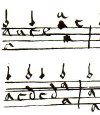
National Library of Scotland ms adv.5.2.15
probably compiled c.1630, though this is a guess; it could date from as early as 1615 or as late as the 1650s. Written by, or for, John Skene (d.1644) of Hallyards, Lothian, or his son William. Written in tablature for the mandore, a kind of small lute.
Editions
William Dauney
Ancient Scotish melodies
Bannatyne Club, Edinburgh (No. 59), 1838
Dauney’s book contains a complete transcription into staff notation of the music in the Skene ms, as well as a substantial discussion, notes and other musical examples. It has 46 pages of transcription, and 1 page of facsimile tablature. It was re-issued as a facsimile by AMS Press, New York, 1973.
Dauney's book is available in its entirety at Google Books.
Early Gaelic harp tunes in this source
p.238-244 (?) Port Ballangowne
Other versions: Straloch: A Port / Port Rorie Dall; Maclean-Clephane: Port 6th
Recommended recordings: None known
Transcriptions: William Dauney, Ancient Scotish melodies, p.229 (staff notation); a facsimile of p.229 of Dauney's book is in Sanger & Kinnaird, Tree of Strings, Kinmor 1992, p. 179.
What else is in this manscript?
This mandore book was written by or for a wealthy East coast aristocrat and contains a selection of different music he world have performed on the mandore. The mauscript is a compilation of eight books containing a repertory of 117 pieces set for the mandore (a small 5 course lute-like instrument). The music is a mixture of English, French and Scots airs.
For an example of the manuscript, please Click here for my Flowers of the Forest class handout, which includes facsimile, transcription, and notes on mandore tuning and tablature.
How to read the manuscript
Click here for some information on how to approach the music in the manuscript.
Simon Chadwick

about this website
© Simon Chadwick
Originally published at clarsach.net, September 2004, first published here 26th November 2004, last updated Nov 2012