
|
In the sixteenth century we start to find more complete information about harp music in the Gaelic world, not least from Elizabethan English writers who were fascinated by the art music of the Gaelic world, and who write charming if not entirely impartial accounts of what they saw and heard1. Though Elizabethan English policy towards Ireland was largely focussed on supressing the old Gaelic society and aristocracy, the harp music in particular seems to have been highly regarded and a number of prominent English aristocrats maintained Irish harpers or purchased Irish harps.
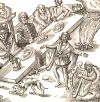
The famous scene illustrated on the right was published in London in 1581, and shows a harper playing to accompany the singing of Gaelic poetry before a wealthy lord2. Descriptions and references describe a ‘classical’ trio of high-status artists, who would work together for an aristocratic patron. The file (poet) would compose elaborate praise poetry in the Classical Gaelic language common to Ireland and Scotland, using complex and difficult metres and structures. This poetry would be presented as song or recitation by the recaire (reciter), who would sing the poem, accompanied by the cruitire (harper) who would play an accompaniment. Though the poems were often written down in a duanaire (poem book) for the patron, the specifics of what music was played and how the poetry was sung remain very unclear to scholars3.
A number of the extant old harps are assumed to date from before the 17th century, but individual instruments cannot yet be accurately dated, and so we cannot be sure which if any of the extant harps should be assigned to the 16th century. The metal fragments from Ballinderry and the Castle Otway harp4 are sometimes said to be of 16th century date. It seems likely that a desire for extra bass notes led harpmakers to construct larger instruments.
Also from the end of the 16th century we have the oldest datable music that was handed down by the old harpers5. Although not written down until much later, tunes like Scotts Lamentation6 and Port Priest7 are likely relics of the 16th century.

about this website
© Simon Chadwick
First published October 2007, last updated March 2011