back prev next Irish harp terms from Bunting
from Edward Bunting, Ancient Music of Ireland (Dublin 1840)
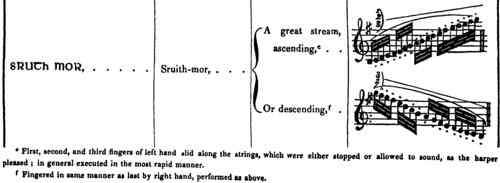
Irish sruth mór spoken by Gráinne Yeats Scottish Gaelic sruth mòr spoken by Tony Dilworth Click the play button to hear it spoken. help ascending:"First, second and third fingers of left hand slid along the strings, which were either stopped or allowed to sound, as the harper pleased..." Click on the picture to watch the video. Bill Taylor Note that although Sruth mor is listed under ‘Graces performed by the treble or left hand’, Bill is playing it with his right hand in the video Note also the musical notation shows the ascending sruth mor starting on comhluighe g, and ascending to d''' which is the highest note on Denis O'Hampsey's Downhill harp. Bill plays a different range. The video shows a legato version. A more staccato effect can be obtained by reducing the distance between the sounding and damping fingers. Maybe this is what Bunting means by "stopped or allowed to sound". The descending sruth mor is marked ‘fingered in the same manner... by the right hand’. This is slightly enigmatic; the right hand can be inverted to allow the same sliding action, but players have suggested other ways to finger a descending sruth mor including using the left (treble) hand, and using the back of the index fingernail while damping with the thumb. more videos coming soon Simon Chadwick 2008 Sruth mor - A great stream ascending / Or descending Spelt sruth mór, 'a great/large stream'. On p.19, discussing Gaelic harping terminology, Bunting writes of "a run of execution, Sruith-mor, or, 'the great stream'". On p.93 of the main text we find an ascending series of notes headed 'Sruith, a stream, played very staccato and soft'. Colm Ó Baoill 2002
Click the play button to hear it spoken. help
ascending:"First, second and third fingers of left hand slid along the strings, which were either stopped or allowed to sound, as the harper pleased..."
Click on the picture to watch the video.
Bill Taylor
Note that although Sruth mor is listed under ‘Graces performed by the treble or left hand’, Bill is playing it with his right hand in the video
Note also the musical notation shows the ascending sruth mor starting on comhluighe g, and ascending to d''' which is the highest note on Denis O'Hampsey's Downhill harp. Bill plays a different range.
The video shows a legato version. A more staccato effect can be obtained by reducing the distance between the sounding and damping fingers. Maybe this is what Bunting means by "stopped or allowed to sound".
The descending sruth mor is marked ‘fingered in the same manner... by the right hand’. This is slightly enigmatic; the right hand can be inverted to allow the same sliding action, but players have suggested other ways to finger a descending sruth mor including using the left (treble) hand, and using the back of the index fingernail while damping with the thumb. more videos coming soon
Simon Chadwick 2008
Sruth mor - A great stream ascending / Or descending
Spelt sruth mór, 'a great/large stream'. On p.19, discussing Gaelic harping terminology, Bunting writes of "a run of execution, Sruith-mor, or, 'the great stream'". On p.93 of the main text we find an ascending series of notes headed 'Sruith, a stream, played very staccato and soft'.
Colm Ó Baoill 2002